


What is the Science of Reading?
“Science of reading” refers to a comprehensive body of research that has supported strategies and methods found to enhance reading. The recommendations that derive from the Science of Reading (SoR) are those that have been consistently supported, over many years, by multiple credible researchers, across multiple settings with a diverse array of students and schools.
Early Literacy Skills and the Science of Reading
One of the most consistently important themes from SoR studies focuses on the question of which early literacy skills must be taught. This question was addressed by the National Reading Panel and more recently by the publication "Foundational Skills to Support Reading for Understanding in Kindergarten Through 3rd Grade" In both of these landmark publications, experts recommended the teaching of the "Big Five" skills which include:
- Phonemic Awareness
- Phonics
- Fluency
- Vocabulary
- Comprehension

Students who master these skills are likely to remain good readers.
Foundation: The Five Pillars of Reading
Early literacy research has given educators a clear and well-validated framework for how children learn to read. The National Reading Panel identified five essential pillars — phonemic awareness, phonics, fluency, vocabulary, and comprehension — as the core components of effective reading instruction. Together, these pillars reflect a simple but powerful truth: learning to read is not a natural process. It requires explicit, systematic instruction that builds skills in a deliberate sequence, beginning with the sounds of spoken language and progressing to fluent, meaningful reading of connected text.
Milestone: Fluency Benchmarks in Grades 2-3
Research consistently shows that hitting fluency benchmarks in Grades 2 and 3 is one of the most important milestones on the road to literacy. Students who can read approximately 90–100 words correctly per minute by the end of Grade 2 have developed enough automaticity to shift their cognitive resources from decoding to understanding — the essential transition from learning to read to reading to learn. Students who do not reach these benchmarks by the end of Grade 3 face significantly greater difficulty with academic reading in later years.
Emerging Research: Writing, Spelling, and Knowledge Building
The science of reading has continued to evolve since the five pillars were established. Emerging research has strengthened the case for spelling and writing instruction as essential partners to phonics and reading — not separate subjects, but integrated components of the same literacy system. Curriculum such as CKLA has also brought renewed attention to the role of background knowledge in reading comprehension, demonstrating that building rich content knowledge in science, history, literature, and the arts directly improves students' ability to understand and engage with complex text.
Reading and Writing: Not Separate Channels
Writing and spelling are not separate subjects that happen alongside reading — they are active practice in the same skills. Every time a student encodes a word in writing, they are doing the same work as decoding in reverse: listening for sounds, connecting those sounds to letters, and applying the same phonics rules they use when reading. That repeated, effortful practice is one of the most powerful ways to build and reinforce the skills that make reading automatic. Students who write and spell regularly are not just demonstrating what they know — they are strengthening it.
This means that when a student struggles with spelling, it is rarely just a spelling problem. Spelling errors are visible evidence of what a student has and has not yet internalized in their phonics knowledge. A student who spells phonetically but inconsistently is telling their teacher exactly where explicit instruction needs to go next. In this way, spelling functions as one of the most honest and actionable indicators a teacher has — far more diagnostic than a multiple choice question, because the student must produce the answer rather than recognize it.
The same is true of writing more broadly. When students write in response to what they read, they are not simply demonstrating comprehension — they are building it. The act of organizing ideas, choosing words, and constructing sentences forces the kind of deep processing that makes meaning stick. Tracking spelling and writing through tools like CBM Writing gives educators a clear, measurable window into whether literacy skills are truly taking hold — and where to focus instruction next.
A Cautionary Note on AI Writing Tools
Writing has value not simply because it produces a finished piece of work, but because of what happens while the work is being done. The effort to find the right word, spell it correctly, organize an idea, and shape a sentence is where much of the learning occurs. Those moments of struggle are not obstacles to literacy; they are the very experiences through which literacy grows.
Research on learning consistently shows that skills develop through practice, repetition, feedback, and productive effort. Students become stronger readers and writers by doing the work themselves. When AI systems routinely generate text on a student's behalf, they can bypass much of the thinking, retrieval, and language processing that literacy development depends upon. In literacy, as in many worthwhile endeavors, growth comes from the work itself. The goal is not simply to produce writing, but to develop the knowledge, language, and habits of mind that writing helps create.
The teaching of reading is the sine qua non of schooling because reading
is the gateway to all academic achievement, and it is
related to social well-being
Early literacy lays the foundation, but it is not the end of reading development. After third grade, students are asked to use reading to learn from increasingly complex text, academic language, and subject-area knowledge. In the Science of Reading framework, successful reading in Grades 4-12 continues to depend on both major strands of Scarborough's Reading rope: accurate, efficient Word Recognition and increasingly sophisticated Language Comprehension.

The most useful adolescent literacy work begins with
skills a school can teach directly, improve over time, and
put to work across many kinds of reading.
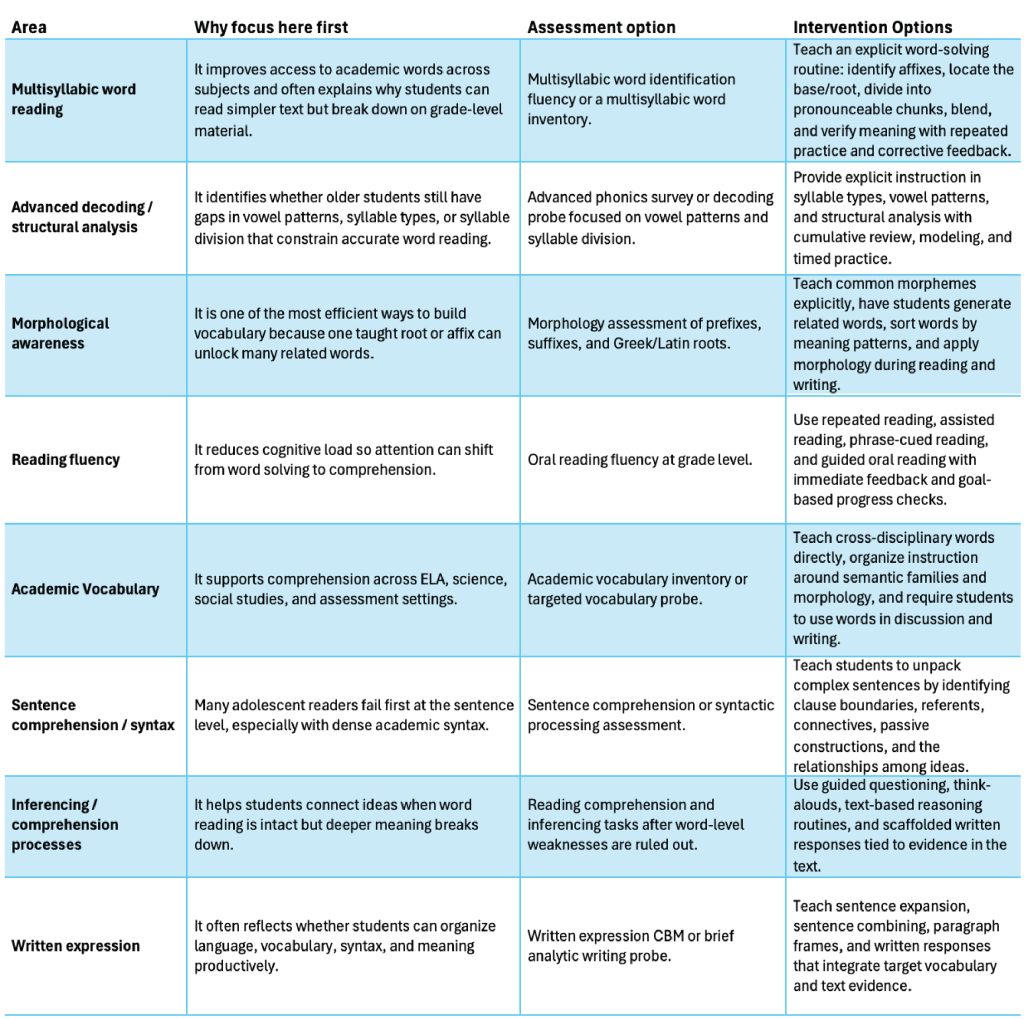
For older struggling readers, the key diagnostic question is not simply whether comprehension is low, but why. A student may have an unresolved word-reading weakness, difficulty reading multisyllabic words fluently, limited knowledge of meaningful word parts, weak academic vocabulary, difficulty understanding complex sentence structures, difficulty making inferences, or some combination of these.
The Secondary Literacy Paradox
Middle and high schools often face a difficult problem: many struggling readers appear to need everything at once - more background knowledge, more vocabulary, stronger comprehension, and greater engagement with complex text. While all of these areas matter, some are much more directly teachable and measurable than others. Broad background knowledge develops over years of reading and learning, whereas skills such as multisyllabic word reading, morphology, fluency, academic vocabulary, sentence comprehension, and inferencing can be assessed directly and targeted systematically.
Where Schools Can Act
The most productive starting point is to identify the specific skill that is constraining later reading performance. These skills should not be treated as unrelated test scores. They form a developmental and functional sequence. For example, weak inferencing may reflect a problem with reasoning itself, but it may also occur because the student does not understand important morphemes, vocabulary, or sentence relationships well enough to construct an accurate meaning from the text.
By examining related skills together, schools can identify the earliest instructionally relevant weakness and begin intervention there. Strengthening that component skill gives students better access to complex text and a stronger path back into grade-level academic learning.
From Diagnosis to Instruction
A strong diagnostic system does more than identify which students are low. It determines which underlying reading skill is most likely contributing to the difficulty and where instruction should begin.
Once that skill is identified, the same precision should continue during intervention. If a student is receiving instruction in morphology, vocabulary, sentence comprehension, or inferencing, progress monitoring should measure growth in that same skill. Returning immediately to a broad comprehension score can obscure whether the intervention itself is working.
The instructional cycle is therefore:

A strong secondary MTSS system works as a gated process: universal screening first, targeted diagnostics second, matched intervention third, and progress monitoring throughout. Grounded in the Science of Reading, this process helps schools distinguish between students with word-recognition or fluency difficulties and those with language or comprehension difficulties, then connect each pattern to a more precise starting point for intervention.
At each stage, teams should identify the target behavior, the instructional routine, the amount of practice, the feedback process, and the measure that will show whether growth is occurring. The more clearly the goal is defined - for example, "accurately read grade-level multisyllabic words" rather than "do better in reading" - the more efficiently schools can choose interventions and judge whether they are working.
Screening and Diagnostic Options
To support this work, iSTEEP provides a range of screening and diagnostic options for grades 4-12. These tools include measures of multisyllabic word reading fluency, vocabulary, inferencing, writing, and other skills that shape adolescent literacy, helping schools build a clearer picture of student needs and make more informed instructional decisions.
Why iSTEEP Stands Out in SOR Assessments:
Comprehensiveness and Personalized Measurement
iSTEEP stands out in supporting districts who take SOR seriously. Here's why:
- All Big 5 Assessments: iSTEEP provides all five essential assessments recommended by the National Reading Panel: Phonemic Awareness, Phonics, Fluency, Vocabulary, and Comprehension.
- Genuine Assessments of Phonemic Awareness and Phonics Skills: Unlike computer-based assessments with limitations in sound production and understanding, CBMs allow students to demonstrate phonemic awareness and phonics skills directly through tasks like listening to and responding with spoken sounds and words. Computer-based assessments often replace important foundational phonics skills with simpler tasks like rhyming, which do not equate in complexity or skill. iSTEEP offers authentic assessments aligned with SOR principles.
- Vocabulary Writing and Language Integration: Acknowledging the fundamental importance of vocabulary and language within the Science of Reading (SOR), our assessment suite is designed to incorporate these key components comprehensively.
- iSTEEP Uses high-quality Curriculum-Based Measures (CBMs). CBM is the gold standard for SOR because the one-on-one approach ensures the skills are assessed in the same way that they are taught to more accurately capture what the student has learned.