


Reading and Math Screening Assessments
The iSTEEP system has a comprehensive library of reading and math screening assessments to help determine which students are in need of additional instructional support services. Screening assessments are available for Grades K-12 for both reading and math. All assessments are conducted on the computer using either computerized assessment or online scoring. The computer conducts the assessments by timing, scoring, and entering the results automatically for you in the iSTEEP database. Online scoring is used for Oral Reading Fluency and other spoken student responses (the assessor marks errors on the computer screen as the student reads). Computer times and scores instantly.
MTSS Process

Assessment Overview
iSTEEP assessments use a curriculum-based measurement (CBM), fixed-form approach designed for efficient screening, diagnostic assessment, and progress monitoring. Unlike computer-adaptive tests that continually change item difficulty based on prior responses, iSTEEP measures use predetermined forms and clearly defined skill targets, making results easy to interpret and directly connected to instruction. Assessments are brief, skill-focused, and organized within developmental sequences so educators can identify where performance begins to break down, select an appropriate instructional starting point, and monitor growth on the same skill being taught.
Reading Assessments
Science of Reading Alignment
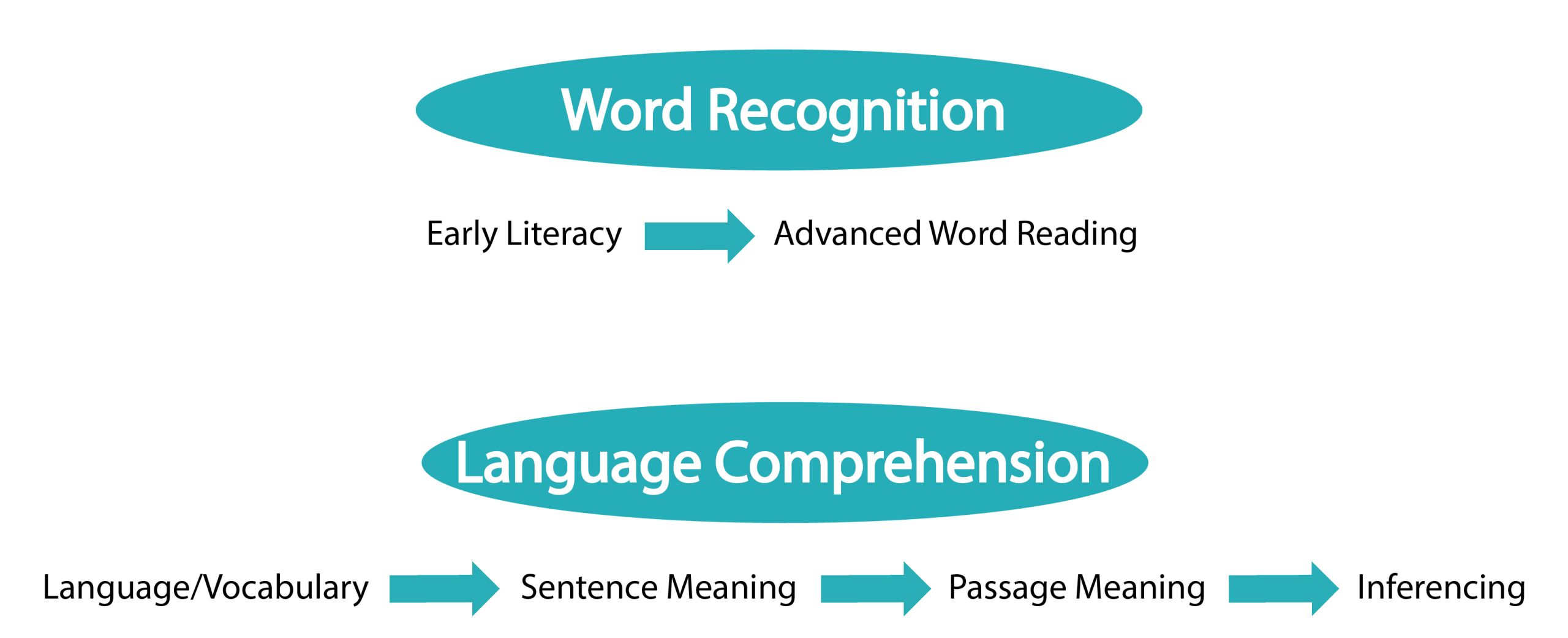
iSTEEP reading assessments are designed around the Science of Reading—the interdisciplinary research base explaining how skilled reading develops, why students experience reading difficulty, and how reading should be assessed and taught. This research shows that successful reading depends on two interacting capacities: Word Recognition, the ability to accurately and efficiently read printed words, and Language Comprehension, the ability to understand the meaning of those words, sentences, and connected text. iSTEEP assessments are organized around these same components so schools can identify not only whether a student is struggling, but also which underlying reading skill is contributing to the difficulty.
Word Reading
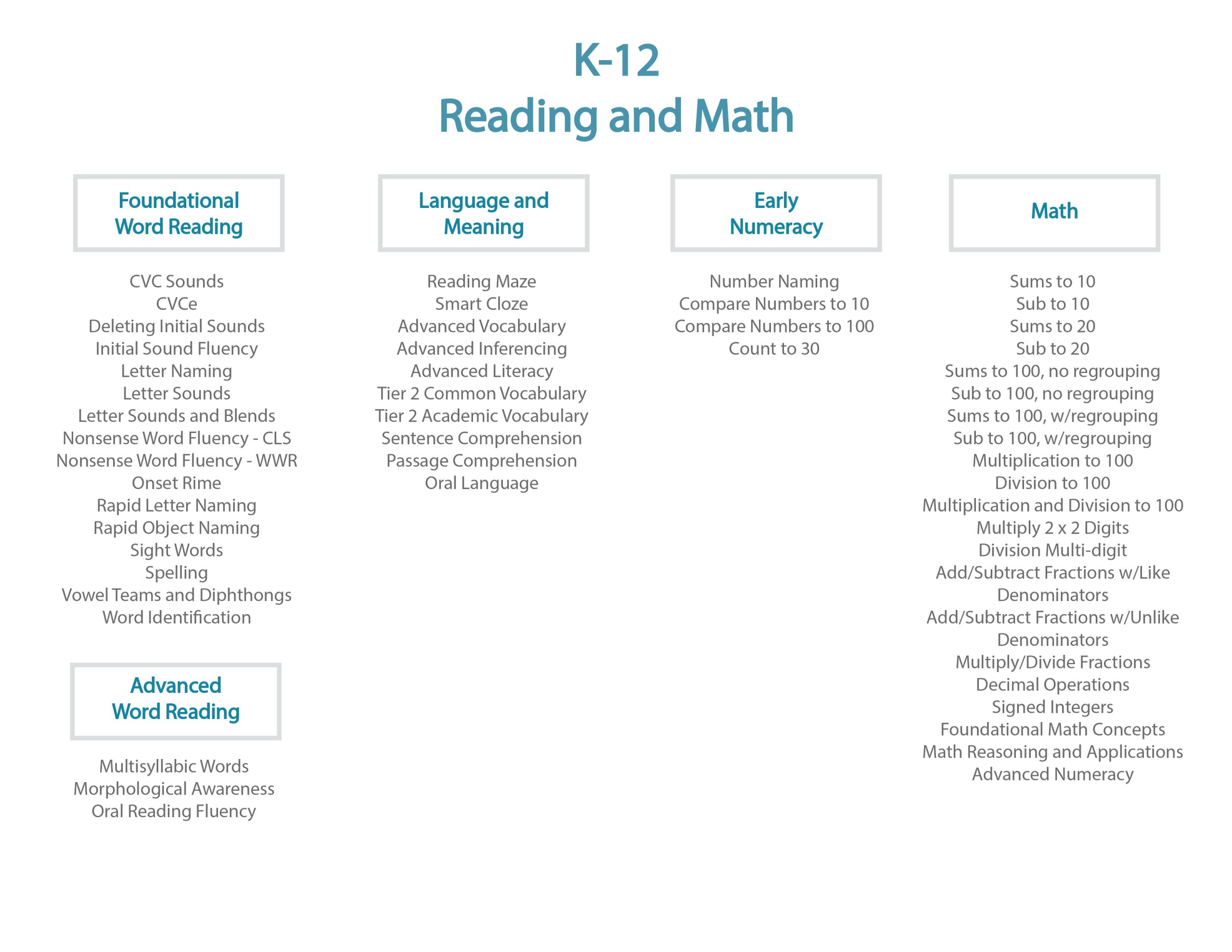
iSTEEP assesses the full developmental sequence of word-reading skills. In the early grades, this includes the foundational skills emphasized by the Science of Reading: phonological and phonemic awareness, letter-sound knowledge, phonics and decoding, word recognition, and oral reading fluency. For older students, assessment extends into advanced word reading, including multisyllabic word reading, morphological awareness, and fluency with increasingly complex text. These measures help schools identify whether an older student’s reading difficulty reflects an unresolved foundational skill or a more advanced word-reading weakness.
Meaning and Language
Reading comprehension depends on more than accurate word reading. Students must also understand word meanings, sentence relationships, and ideas that develop across connected text. iSTEEP assesses key Language Comprehension skills including general and academic vocabulary, morphological meaning, sentence comprehension, passage comprehension, and inferencing. These skills are examined in relation to one another so educators can determine whether weak comprehension reflects difficulty with vocabulary, word parts, sentence structure, reasoning, or broader understanding of text. This helps identify the most appropriate instructional starting point rather than treating low comprehension as a single, undifferentiated problem.
Math Assessments
iSTEEP math assessments are organized around a developmental sequence that moves from early numeracy, through math computation, to mathematical reasoning and application. This structure allows schools to use the assessments for universal screening, diagnostic follow-up, intervention planning, and progress monitoring. Rather than relying only on a broad math score, iSTEEP can help educators identify the specific prerequisite skill that is limiting a student’s performance.
Early Numeracy
Early Numeracy measures the foundational number skills that support later mathematics learning. These include number naming, comparing quantities, counting, addition and subtraction within 10, and addition and subtraction within 20. The sequence helps schools identify whether a student has developed the basic number concepts and early computation skills needed for more advanced mathematics.
Math Computation
Math Computation extends the sequence from basic arithmetic through increasingly advanced computational skills. Measures include addition and subtraction within 100 with and without regrouping, multiplication and division facts, multidigit multiplication and division, fraction operations, decimal operations, and signed integers. Because these skills are organized developmentally, assessment can help identify the earliest computational weakness that may be interfering with success on more advanced mathematics.
Math Reasoning and Application
Strong mathematics performance also requires students to understand concepts, recognize mathematical relationships, and apply skills to unfamiliar problems. iSTEEP assesses these broader abilities through Foundational Math Concepts, Math Reasoning and Applications, and Advanced Numeracy. These measures examine whether students can use their mathematical knowledge effectively, not simply perform isolated calculations.
Together, the iSTEEP math assessments provide a progression from foundational number sense → computation → reasoning and application, allowing educators to move from broad identification of difficulty to a more precise understanding of where instruction should begin.
Easy to Understand Reporting
There are multiple reporting options available to review easy to interpret screening data. Quickly identify students in the red zone or based on national percentile rankings. Reports can be broken down by:
- Individual student reports
- Classwide
- Gradewide
- Schoolwide
- Districtwide
Classwide/Gradewide Report - Grade 3
All Assessment Level l 07/01/2026 - 10/31/2026 l Assessed 08/16/2026
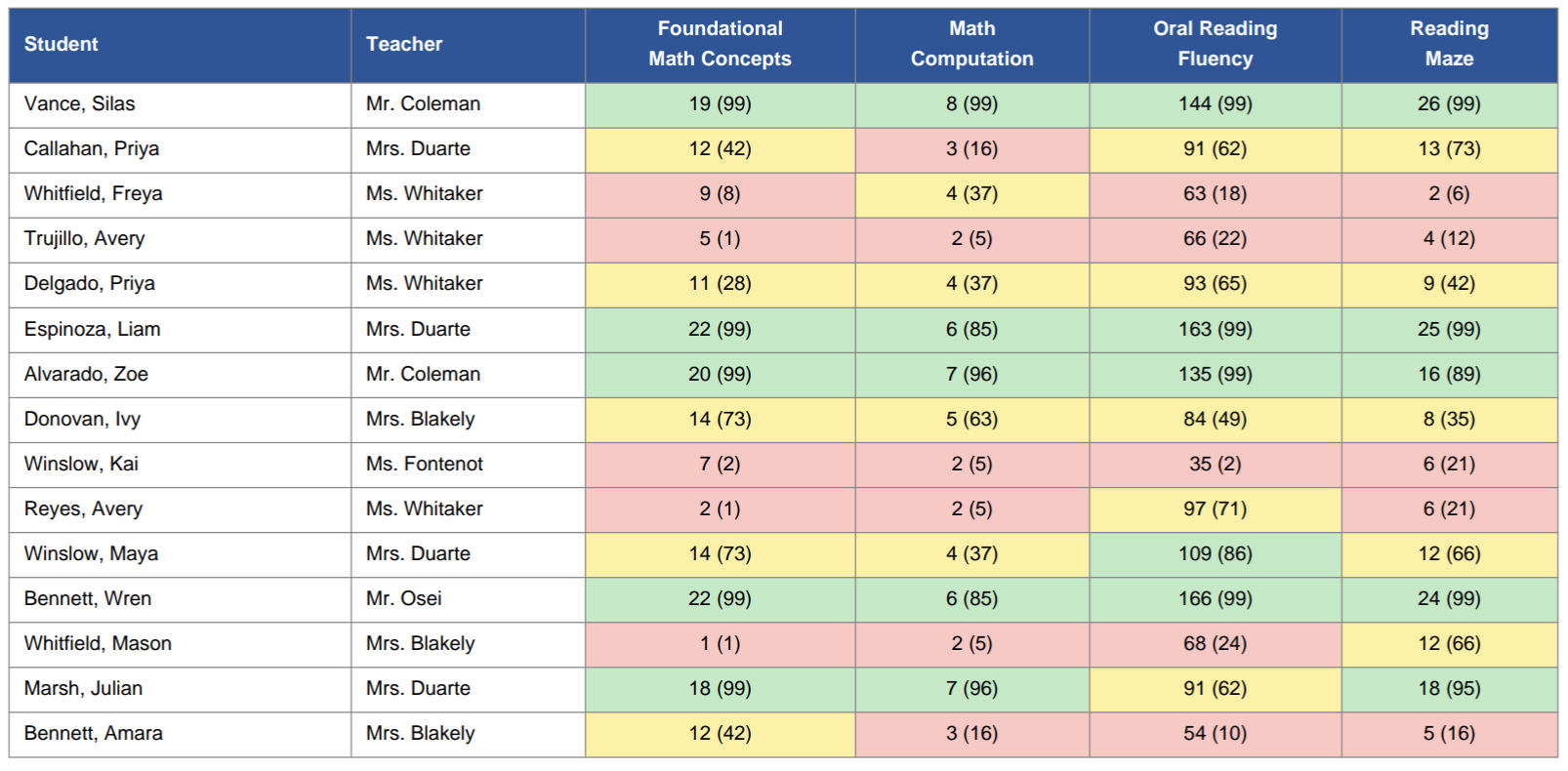
Note: Student and teacher names are fictional

Screening unlocks the door to personalized learning, but the journey doesn't stop there. What kind of intervention is right for each student? How can you track their progress effectively?
Let iSTEEP guide you through every step, from identification to intervention and beyond!